A World Down Under

Grandma’s kitchen on a Sunday afternoon; sauce bubbling on the stove and steam coating the windows; a favorite easy chair worn in the proper places with a light beside it that cast just the right amber glow of an old incandescent, which is the perfect illumination for reading well into the late hours; the back porch of the old homestead, (read The Corner of 18th and Morton.) Everyone has a favorite place and most of us have more than one.

Anyone who lives in an old house knows the pros and cons of an old sandstone basement. It is a portion of the house rarely seen by company. There is nothing in these old dugouts worth showing to visitors. It is also where things go that are out of service and forgotten until it is time for the neighborhood yard sale.

Old basements are the dwelling places of the fire breathing monsters that come to life and roar just as you get your hands on the can of cream corn mom sent you to fetch. You hit the first step with the speed of an Olympian and close the door tight behind at the top of the stairs. The upstairs world is much safer but not nearly as entertaining.

The basement is a hiding place from the storms which plagued the plains and it is also what requires bailing out when the rains become so intense and the sandstone turns to sponge allowing all the surface water to poor through its walls.

With all of its challenges, the basement of our old house, is still one my favorite places.

Ours was a sandstone basement with a cement floor. Family legend has it when the house was built over one hundred years ago, the original owners lived in the basement until they could build the upper floors. Under the steps, in the darkest corner of the dungeon, was an old hand water pump remnants of the days when this was the most modern of conveniences, a form of indoor plumbing. The ceiling was a good ten feet high and lined with all of the wires and pipes snaking to the rest of the house.

The steps of the sandstone hole ran nearly straight up from the basement. When you stood at the top it was almost like you were going to jump to the lower level. At the bottom was a landing with three short steps to the basement floor. Somewhere along the line, the steps and railing was painted a light robin egg blue. That color did not show up anywhere else in the house, which leads me to believe it was a purposeful color choice. The walls to the right of the steps were lined with peg board on which held everything from mom’s favorite popcorn pot to dad’s flour infused baking apron. The ledge below the peg board was lined with car waxes that had seen better days, bug sprays, and a few mixtures of Miracle Grow that I think might still be fermenting under the watchful eye of the new owners. Since the house did not have a pantry (that space was turned into a second bathroom) the basement ledge and wall was a sufficient stand in.

The last three steps served as my work bench for many years. I was too short to work at dad’s bench so any sawing or hammering was done on those step using them as my sawhorses. Many kite ribs were fashioned there along with a few homemade skateboards and pigeon perches. Each of the last steps carries scars from my over cuts with the hand saw. Mom was convinced I was going to saw right through the steps someday, but they held up ok in spite of my poor carpentry.

The “ground level” was divided into four rooms, each having its own purpose and history. The main room housed dad’s workbench and several sub benches dedicated to different sanders and saws for his toy making projects. Off the main room was the home of the monster. It sat like Jabba the Hut with tentacles reaching to all parts of the house. It had an opening where you could look into the pit of Hell as it fired up to heat the house. It erupted to life on a regular basis but every once in a while it required dad to pay it some special attention just like Mr. Parker “the Old Man” in “The Christmas story.”

When the house was updated with a new gas furnace, dad and I spent several days dismantling the old furnace. Tearing it apart was like being the victor of an epic battle and now we were allowed in to see the secret workings of the enemy. A few hard blows with a sledge hammer brought Jabba to his knees and we carried him out piece by piece and spread him out on the yard for all to see his defeat. We loaded the heavy pieces in Jim Riders old lime green 1948 Ford truck. (This truck will play a key role in a future story Flight 250) We had the back bumper almost scraping the road when we took the pieces to the scrap yard. My share of the scrap bought my first pair of pigeons.

What was left behind in the basement was now a room matching the size of the main room with the exception of a pit better than a foot deep and almost six feet across. There was a tunnel leading from the pit which was the cold air return when the monster was alive. Dad challenged me to crawl in which I did, making it all of the way to the upturned shaft. After a brief panic of how do I get out of here now, dad talked me back to the light of day but I knew I had been where no man had gone before and never will again. The pit was filled in with cement but the tunnel was blocked to save on the slurry mixture. Someday when the house comes down, they will find the tunnel and wonder if anyone ever explored this part of the planet.

The space left behind was eventually sectioned off and one part became a “Ham Shack” for Tom’s amateur radio hobby the other side became an additional workroom for dad. This workspace was more for finishing work on his toys, making new patterns from ideas he gathered from books and magazines as well as some of his writing and sketching.

At the end of the newly created workspace was what was always referred to as the monstrosity, the real name for it was a Hoosier Cabinet. What was a piece of prairie kitchen luxury with all of its cupboards, pull out cutting boards and flour dispenser, now housed pens, brushes, countless sheets of tracing paper, tobacco and a few pipes.

Dad worked in this space often late in the evenings when he couldn’t make noise with the power tools in the main room. The space was also directly below the cold air return in the “playroom.” When dad would smoke his pipe, the sweet scent of pipe tobacco came up through the gates and if positioned yourself just right, you could look down on dad sitting in his chair working his perfect penmanship recording some of the family history or putting the finishing touches with fine brushes on his latest toy creation.

The main room was where dad’s primary work bench was stationed. Two windows high up on the wall opened to the brick patio on the east side of the house. The windows looked down on the bench like two bright eyes of a face the objects on the wall filled in for a nose and the bench itself provided a smirk of a smile turned up on one end by a large vise. It was a space you walked into bathed with creativity and turpentine. Books lined the wall to the right of the bench. Each book took the creator into a world of ferris wheels, merry go rounds, and wooden puzzles. Tacked to the wall were tracings ready to be moved to wood someday. All around finished toys, boxes, puzzles and various creations sat ready for a new home or a view of the upstairs world for a few weeks, or until mom got tired of dusting.
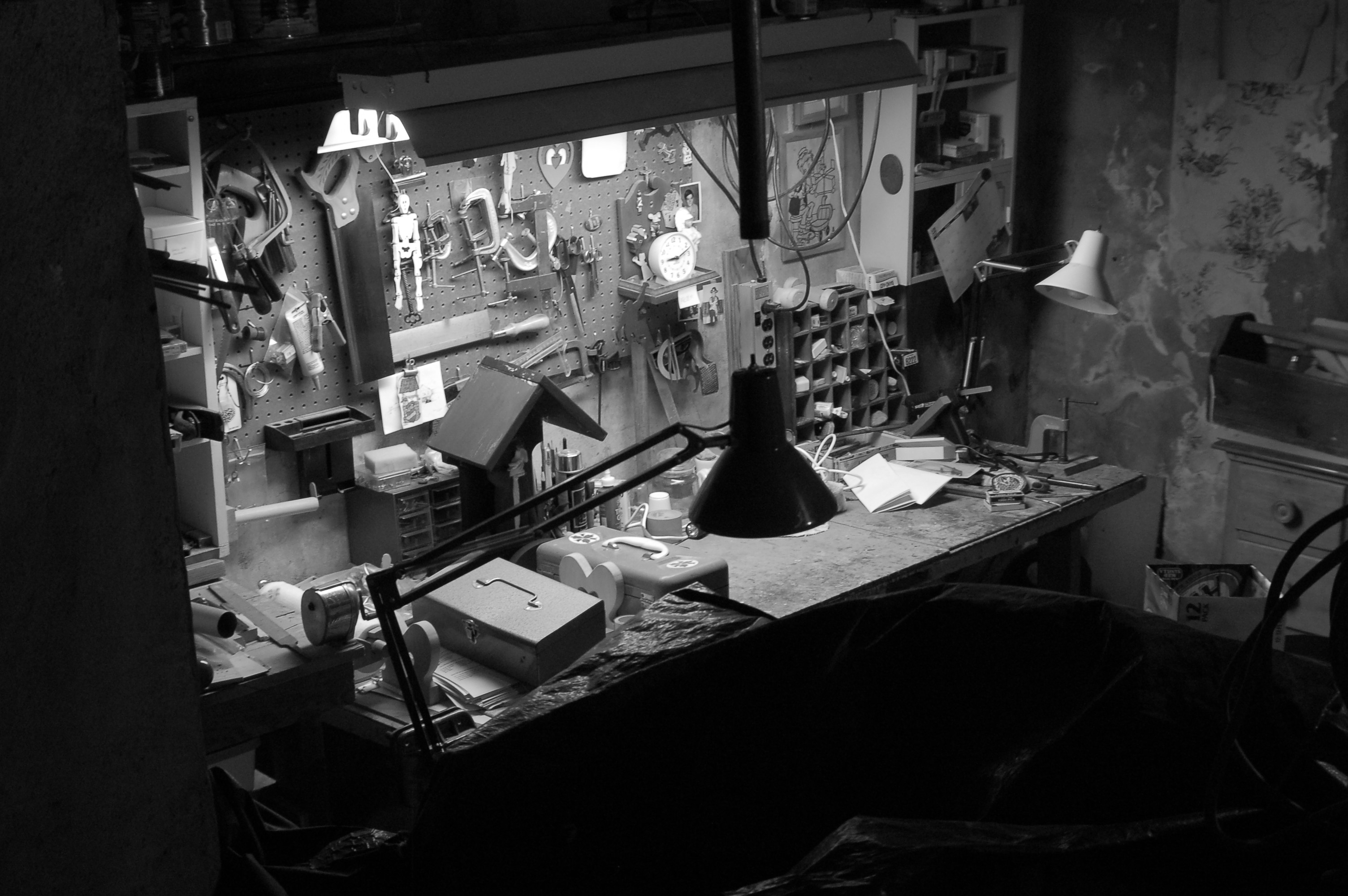
Dads basement work bench.

Dads basement work bench.

It was from this bench that dad crafted a treasure box presented to me one Christmas. It is not an easy task making a wooden box. Anyone who has worked in a house where they thought the room was square, can appreciate the accuracy of making a small wooden box that meets on all corners. This box has lasted through countless yearly cleanups, moves, and numerous fits of “should I keep this.” The purpose was to place things inside that I valued. Over the years that changed but in writing this, I pulled it out to see just what remained. Some items I can tell you with no hesitation why I saved them, others I have no idea other than it had some importance at one time.

wpid-img_20141202_072304184.jpg

Creations from this bench have found their way across much of America. In later years when there seemed to be more visitors to the house, the inventory of wooden toys, and other creations began to find new homes. Many times dad was asked if he would sell his creations but that was a process he refused. However, if you wanted or admired a piece it was yours. As Teresa’s friends started spending time in the house on college breaks, dad would bring his latest construction up from the lower level. This usually prompted a visit down under to see the rest of Santa’s workshop. When a piece left the house it fulfilled two important roles. It relieved mom of having to say, “When are you going to start clearing some of these out? and…it made additional space for a new model.

You could leave the basement by way of the outside cellar door. You need to understand in the Casey vocabulary, there is a difference between a cellar and the basement. If you wanted to go into the basement you went down the death defying steps through the downstairs half bath. If you were going to the cellar, it was outside, open the cellar door, never called the basement door, and go down the always cold, slimy wet steps to a “cellar way” which was actually the space under the back porch. Along the cellar way you passed a window to nowhere, once again a remnant of days when they lived in the basement. This was probably their only real view of the world while trapped in the subterranean chamber.

At the end of the cellar way was the door leading into the basement. It was childproof in that you had to have reached some level of physical maturity to be able to bust through the door as it swelled shut with dampness and stretching of old wood. The cellar way was the safe haven from storms. Many nights we were rousted from bed to the sounds of sirens blaring a warning of approaching storms. Huddled in the cellar way you could hear the rain slamming the porch side of the house and an occasion crack of a branch from the numerous Dutch elm trees lining the 18th street side of the house. Once the all clear was signaled, we made the trek back up the incline and worked on trying to get back to sleep.

In 1973, the basement took on a new character. A deluge settled itself over Falls City and the rain came as if it was trying to float the Ark once again. It was a late August storm which sometimes is Mother Nature trying to get her last licks in before Jack Frost moves in to claim his territory. This makes for a lot of showing off among the nature gods. Well, the old basement had enough of this and gave up the fight. Water poured through the sandstone with more fury than the mighty Missouri River at spring thaw. What was the area of the old hand pump became reactivated from the spring underneath. Water poured through the walls and bubbled up from the floor. The bucket brigade of Caseys trying to bail a sinking ship and dodging lightning bolts when pitching buckets outside would have made a good 60 Minute segment. Bucket after bucket carried across the floor, up the cellar way, pitched to the yard, repeat…turned the haven of peace and relaxation into a cement swamp of floating sawdust, never to be used again bath towels and grass brought in from the yard. The next day, I loaded up with fourteen other guys from Nebraska and took off for a seminary in Kentucky. The rain of the night before was quickly climbing back to its homeland as steam from the August heat. The folks were dead tired, Teresa was spent, and I was just ready to start a new adventure. Scared as heck, but ready.

It was, all part of growing up.

###

Go back

Your message has been sent

Warning
Warning
Warning
Warning

Warning.

The Corner of 18th and Morton


No one speaks.

There’s no need, there is enough other conversation going on.

Crickets are chirping signaling a muggy night. Nighthawks screech in their search for high-flying insects. The ghost of a breeze blows across legs, tickling as well as refreshing. The wind brings with it a mildewed perfume from the journey over the Nemaha River.

A coal train out of Colorado passing through on the way to an eastern seaport, blows a horn as it comes to the Fulton street crossing south of town. The tap click tap click of the wheels crossing the joints talks back to the crickets. The train fades, passing through cornfields surrounding town.

A chain on the empty flag pole in the neighbor’s yard across the street sends a sporadic ping as the draught convinces it to move.

The fragrance from a bowl of tobacco makes the rounds of those gathered for the evening. The earthy smoke gives a hint of fall, a season still far off.

Occasionally a car passes. Not fast, just passes.

….That is what a night on the Casey back porch was like.

Back Porch

Back Porch

All of the stories which I have shared so far dealt with events. Actions and situations are what shape our lives and let emotions live outside our bodies. From the comments, which I cherish, I know the stories have triggered happy memories for readers. Now, I am going to change it up for a couple of weeks and talk about special places that fashioned my growth pattern.

I invite you to share in the comments section your favorite places or the secret corners you retreated to.

If I could visit one room of the old house it would be the back porch. The room was screened on all sides and supplied with the most comfortable chairs of the house. It was easier to fall asleep on the porch chairs than it was on the living room sofa.  Mom guarded those chairs with more care than her indoor furniture. Every year they received a thorough washing down as well as a nightly rub off with an old wash cloth that was stored by the back door. Like any good screen porch it had a screen door with a spring when stretched played its own distinctive tune.  If you didn’t catch the door on its return, it would wake the cat-napping residents with a loud slap. I believe mothers across the country share a common phrase which I heard over and over, “Don’t let the door slam.”

A set of wind chimes hung in the corner. Over the years they became pitted from acid rain and dents from windstorms. When you called home to talk to the folks, who were usually on the porch, the chimes would invite themselves into the conversation. Their music seemed to improve with natures shaping and each season they played a different tune.

The porch floor was made of tongue and groove wood that was painted dark green every couple of years. Sometimes mom took on the job but most of the time it fell to dad. In later years the task was surrendered and old bones and arthritis won the fight preventing the usual maintenance. When we finally sold the house after dad’s passing, paint was peeling and the porch deck lost much of the gloss of the latest painting.

Between the two chairs was a small round stand covered on top with a left over piece of the kitchen linoleum. Permanent items on the table were dad’s pipe of the day, a fingernail file to manicure his perfect nails, the ashtray that looked like a rubber tire from a lawn mower (which found a way to my smoke stand) and a newspaper folded around the crossword puzzle that dad would work on until the day’s light faded.

Mom’s contribution to the porch were a few potted geraniums which she nursed through the hot summers. A blue plastic watering can was kept in the corner where a broom stood at parade rest waiting for the next order. Sitting beside this working class team was a plastic jug filled with the latest concoction guaranteed to nurse the geraniums to their full bloom. I think each year mom tried a different potion. To be honest, each year looked just as nice as the last.

The porch faced due south with the east and west sides being just as open as the front. This openness gave the porch perched participant (say that three times fast) full view of the neighborhood of Morton Street as well as the activity in numerous backyards. On the porch you were blessed with an unobstructed view west of the traffic on highway 73 and a good perspective east up 18th street towards Saints Peter and Paul Church.  If nothing was happening in any of those directions your entertainment was in the backyard which was filled with the attics of rabbits, the high wire acts of the squirrels and the popular bird bath along the back walk. The bird bath was the great critter equalizer. It was like the watering holes of the African Serengeti. No creature dared violate the code of fresh water which belonged to everyone, although, I do believe a few ornery blue jays tapped on the kitchen window from time to time wondering when dad was going to refill the bowl.

Looking up 18th Street

Looking up 18th Street

If you positioned yourself just right on the porch, you could command the neighborhoods coming and goings like Oz behind the curtain. If Mrs. Young across the street let her dog out, that was logged. If the guy renting the apartment down the street above Butch’s grandmother’s place pulled out, you knew he was making a cigarette or beer run. The people living in the old Saul place on the adjacent corner all worked different shifts. One would come home, park the pickup and within minutes, it was moving again for the next shift worker. There was never a need for a clock on the porch. The neighbor activity was as reliable as a sundial.

On summer days, before air-conditioning, the porch was where you went to feel some real air. When the folks grew older and blood became thinner, they would retreat to the porch to warm up while the rest of us weaklings opted for the fake air of the house. There is a fact about Nebraska and that is the wind always blows. It is not always a cooling breeze, but at least it is air moving. Wind in Nebraska feels like turning a blow dryer on your face. On the porch you could at least position yourself to feel some of the breeze over your sweaty skin. On hot days you were often accompanied on the porch by metal drink tumblers filled with ice water or lemonade. I think they kept drinks colder than any modern attempt at insulating. The cups themselves would sweat as much or more than us. By the time you finished your drink, you had a trail of drips up your shirt from the wet tumbler as well as a substantial puddle on the table.

The Casey porch was a family room, counseling center, neighborhood gathering place and also a place you were confined to if you deliberately violated one of mom’s rules. More than once I heard the words, “If you get off this porch before I tell you, you will be in bigger trouble.”

The porch was the place to enjoy mom or dad’s dessert of the week. The dessert menu was always planned in the house well before the main courses. Dad made sure there was always a bread or a batch of cookies, mom covered the pies and cakes. Dessert was considered as much a part of the meal as pass the salt please. For that reason, it was always served before the kitchen was picked up and the dishes washed. No fancy trays made their way to the outside. Every person carried their cake and coffee delicately balancing them passing through the door to the porch. Once outside, we settled in to monitoring the neighborhood activity until someone declared bath time. At that point the porch population would come and go depending on whose turn it was in the tub. When a freshly bathed family member returned, they declared a ritual saying, “Now I am the cleanest one in the house.”

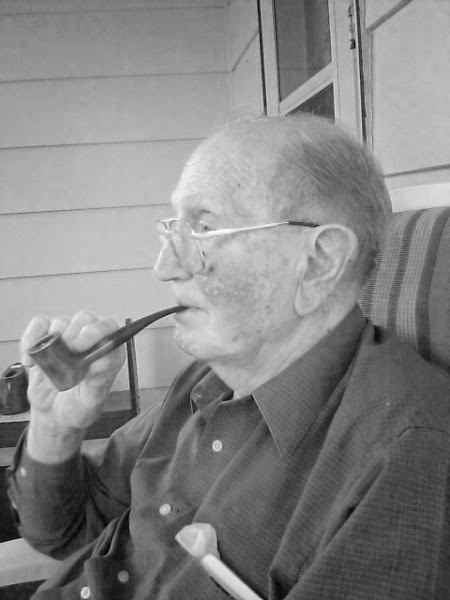
When mom passed, the porch lost some of its attraction. Dad kept up the porch tradition. He maintained his chair and the geraniums with the same attention that mom would extend. As Teresa and I would come and go spending time with him, the porch was a retreat with him. Teresa and dad would share a love of reading while spending time together on the porch. Dad and I would share the evening smoking our pipes and every once in a while, he would share a childhood memory maybe evoked by the gentle roll of tobacco smoke.

Francis Casey and his pipe

Francis Casey and his pipe

The night before dad’s funeral, as a family, we all gathered on the porch for a true Irish wake. Combinations of alcohol, stories and booze inspired philosophical declarations carried us well into the early morning hours. The porch was put to rest in the same way as the last of the Casey clan would be the next day.

Time spent on the porch was… all part of growing up.

###

Go back

Your message has been sent

Warning
Warning
Warning
Warning

Warning.

Midnight 911

If you have never attended Midnight Mass you are missing a beautiful event. Next to Easter it is one of the most anticipated celebrations on the calendar. Regardless of the denomination, Easter and Christmas are the two days when the churches are packed with parishioners spilling out to the aisles.

Midnight Mass is also one of the most decorated of all the Masses. The sanctuary is adorned with pine, poinsettias, trees and other trappings of Christmas. In many churches, the transformation from the repentant Advent season morphs into the beauty of the season almost overnight by an army of volunteers. Those volunteers are proud, rightfully so, of their accomplishment. All of this work adds to the beauty of the celebration.

As a young altar server, to be selected to serve at this pinnacle of the season was an honor and as you can imagine…my story unfolds from here.

I started my career on the altar when we were still required to memorize the Latin prayers. Sister Marie, (from the blog “Your Hand will Stick out of the Grave 10/10/14 fame) was the examiner testing our proficiency with the prayers. You didn’t step on the altar until she gave her approval.

Once you mastered the Latin responses and went through the drills to learn your duties and positions on the altar, you were placed on the schedule of Sunday and weekly morning Masses. The early morning Masses were the real challenge. It meant getting up well before normal school time and then walking up the four blocks to church in the dark. If you were dependable in these early mornings, it wasn’t long before you were moved up the scale of serving at funerals, which got you out of a couple hours of class and put you in line for an occasional wedding on the weekends.

I soon turned altar serving into a for profit position. I was the server called on for funerals, weddings and special occasions. The pastors, of which I went through three in my tenure, soon turned to me as their master of ceremonies for all of the liturgical events. It was my responsibility to make sure everyone knew their place, the altar was ready to go, and we had enough personnel to carry out the celebration. For this service, I was usually slipped a few bucks by the priest, the family of the bride or the local funeral director.

Not a bad part-time job.

The first Midnight Mass of my MC career arrived. The church was decorated with Christmas trees on each of the side altars. Poinsettias were in every nook and cranny of St. Peter and Paul. The back altar with a carved wood back drop climbed to the ceiling. Injected at each level was a shelf holding a candelabra surrounded by poinsettias and the statues of the patron saints, Peter and Paul.

As midnight drew closer the church filled from front to back, quite opposite of the usual pattern of Sunday mornings. The church was dark with the exception of the red sanctuary light which cast a strange glow on those in the first pews. Around 11:30 the tradition of the living Rosary started. Students from the high school would walk in carrying blue or red votive candles depicting their role in the rosary decades. When it was over, the church took on the warm glow of mixed colors blended with the soft sounds of the choir. The atmosphere that inspired “Silent Night” settled on the whole congregation.

The time to light up the altar arrived. As the oldest server, and also the tallest, the honor and duty of lighting all of the candles fell to me. The candles on the lower front altar were no challenge. As the candle flames multiplied, so did the light cast from the sanctuary.

The next task was the candles on the back altar. Again, those on the lower back altar proved to be easy to light. Now it was time to tackle those on the next level.

With the candle lighter extended to maximum length, I was able to reach the highest candle by stretching myself out to my longest length.

Now if you employ a little knowledge of physics you can understand some of the dynamics of the actions that follow. When you have a pole reaching out six or seven feet, movement of several inches at one end transmits to twelve inches or better on the other end. If you stick a flame on the end of it, it now looks like a bouncing tongue of flame in the darkness.

With a full church behind me and nothing more for them to do than watch this process, I had the congregation’s full attention. Mothers grasped fathers with vise grip fear while they covered the eyes of sleepy little children with their free hand. The bouncing flame moved from one candle to the next each time coming closer to the dry wooden altar façade. Each level up required more of a stretch and with each stretch the ability to hit the target candle lessened.

With one miss swing the flame touched the leaf of the closest Christmas flower. Don’t ever let anyone tell you that poinsettias are not flammable. A collection of ooOOs and aaAAHHs rose from the crowd behind me. You would think they were attending the July 4th fireworks, not the December 24th holy celebration. The poinsettia went up in a flash and in my mind I pictured the entire back altar going up in a blazing apocalypse.

Thank God, this was pre-cell phone days. I am sure the thumbs would have been hitting 911 before the first leaf went up. Once again my guardian angel was tested. He must have flown up and with one mighty blow, extinguished the flower as quickly as it erupted. A blackened pot sat there as obvious as a black dog in a snow storm. This was fortunately the last of the candles to be lit. There was nowhere for me to hide. I only had one recourse and that was to retreat to the sacristy with the hope that Fr. Chonta was not paying attention to the congregation’s reactions.

All was fine until the opening procession for the Mass. As we approached the altar Fr. Chonta had to be blind not to see the glaring charred pot sitting under the statue of St. Peter. Being the saintly man that he was, he never mentioned the obvious eyesore. I think we were both secretly thankful St. Peter was a rock and not one of the wooden statues of the side altars.

Midnight Mass was…all part of growing up.

Altar Boy

By James Metcalfe

“Garden of my Heart”

(One my mother’s meditation books)

 In cassock and surplice white…He takes his privileged place…To serve the priest at Holy Mass…With reverence and grace…He kneels and stands with folded hands…And piously he shares…The Latin words and phrases of… Profound liturgical prayers… He moves the missal and the cloth… He sounds the altar chimes…The designated times…At benedictions he is there…To swing the censer high…And waft the fragrant incense to…The angels in the sky…He is the acolyte of God…Whose special time is spent…In serving Mass and being near…The Blessed Sacrament.

###

Go back

Your message has been sent

Warning
Warning
Warning
Warning

Warning.

Behind Closed Doors

The stories many could tell about what went on behind the closed doors of their homes could fill volumes. To select which of those stories to share or better yet, which stories are shareable is a delicate task. Parents cringe when children start to tell a story that borders on “too much information.” I have little doubt people wondered what went on behind the doors of 1804 Morton Street. Few stories leaked out through the cracks of casual conversation because as kids we were well trained in the art of what happened in the house stayed in the house.

Mom and dad were not real social butterflies. I can’t recall people coming by the house for parties or the folks visiting friends just for the sake of a visit. Mom never worked outside of the house so there was never a meeting of work colleagues or business meeting in the house. She did a stint as a 4-H moderator which at times filled the house with an occasional ban of teenage girls. During these meetings I was required to stay in the basement. I don’t know if this was my mom’s rule or my sister’s request. There must have been an Igor like quality about me that they wanted to hide.

Dad worked a split shift at the Post Office and was a member of the local National Guard unit. Like mom, he never had a reason to have work buddies at the house. We heard the names of the other carriers but never really put a face to them. While dad was with the guards he helped with the Explorer Scouts sponsored by the guard company. This pretty much sums up the extent of the community outreach from the Casey household.

A visit by a relative to our house was a rare event. Even the few that lived in Falls City were only seen at Sunday Mass, funerals and an occasional catch up conversation at the local Hinky Dinky grocery store. The exception to this was mom’s sister Aunt Betty. She was good for a weekly visit to the house. Aunt Betty would pull up and I knew for the next two hours the house would be filled with the smell of cigarette smoke and coffee. Betty would go through numerous cigarettes while mom downed cups of coffee poured from the green glass percolator on the stove. While this was going on, I would sit listening to these two sisters complain about their siblings, recall stories about their parents and share recipes back and forth.

Neither mom nor dad’s families were big on reunions. Mom’s family tried to have a few reunions but that soon fizzled out or maybe they just stopped telling us when and where they were having them. If you asked me to pick out relatives in a line up, I would be hard pressed to identify the right suspects.

Allow me to illustrate:

One summer day while home alone, the phone rang with the disturbing ring characteristic of the old rotary dial phones. The caller said, “We are from California and we are just passing through Falls City and Rose Schlosser said to give you a call and say hi.”

I politely informed the caller that they must have the wrong number, and that we did not know any Rose Schlosser.

Within minutes the caller rang again. This time they verified they were calling the right number. In the most polite way I could muster, I assured them that we did not know anyone by that name.

That evening, we were sitting around the supper table just having casual conversation. I shared with the folks the strange phone call I intercepted while they were gone. I told mom and dad I reassured the caller that we did not know any Rose Schlosser.

Mom, sitting to the left of me, was getting that look on her face of, “Oh no, my special son has struck again.” With her typical calm but you knew your where in trouble look she said, “you idiot, (this was the only time I ever heard mom use this word) that is my sister in California!”

How was I to know? I never heard about her and I certainly never met her.

You know, I don’t ever recall hearing about her from that point on either.

When holidays came around we never had to round up extra chairs and there was no such thing as needing an extra freezer or refrigerator to store large amounts of food. Occasionally we were visited by one or both of the grandmothers but even that was a rare event. Most often it was the six of us around the table enjoying a simple holiday meal. Mom was not into any fancy dishes and it wasn’t until I married into my wife’s Italian family that I found out there was more food than turkey and ham for holidays.

We did however celebrate holidays and special occasions in ways that would make those around us wonder what was going on in our house. St. Patrick’s Day was always a special day in the house. On St. Patrick’s Day the house was loaded with shamrocks, leprechauns and green top hats. Dad would bake his special Irish tea bread served with orange marmalade. Mom would set out cold cuts, cheese and crackers and we were allowed to drink a whole bottle of root beer or cream soda. To make the day even more special, dad would fly the Irish flag from the back porch and place stereo speakers in the upstairs window with the goal of filling the neighborhood with Irish melodies.

Halloween was another special day in the Casey house. Dad was always cooking up something special for the day. One year between the characters he created and the sound effects produced by Tom, there was very little candy passed out. You could see mothers and fathers moving their little goblins across the street to safety.

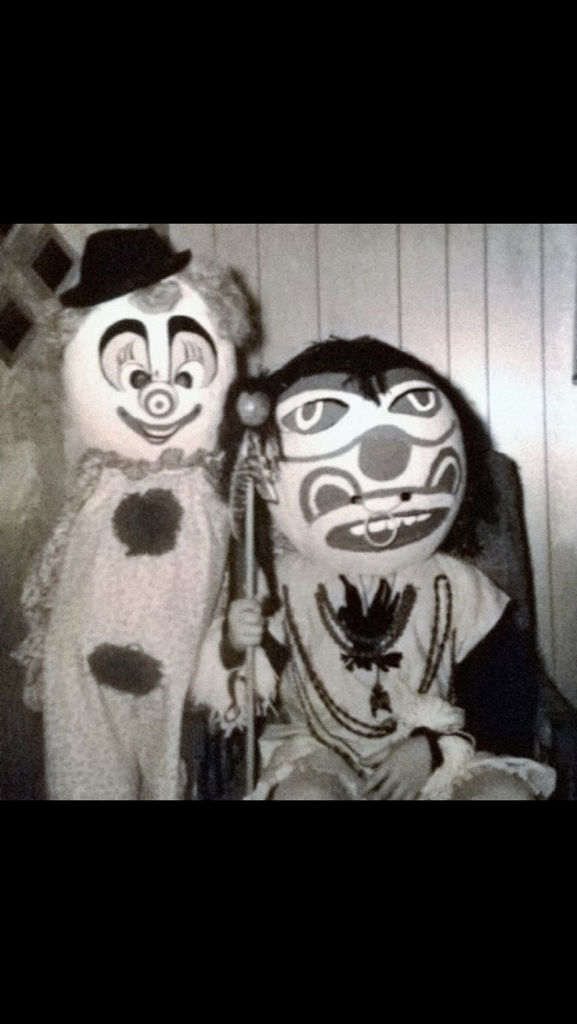
For several years in a row, the Casey kids took top costume prize in the annual Halloween Parade. The costumes that dad created in his basement workshop were some of the most anticipated creations of the season. Of course we won’t go in to the details of dads little disturbing the peace incident years ago at a local parade. Let’s just say it involved a costume that the horses didn’t like. His defense, the riders should have had more control of their horses.

Two of dads Halloween creations. Teresa and Brian

Two of dads Halloween creations.
Teresa and Brian

Despite some of the evil and twisted tendency you might be attributing to the Casey clan from the previous stories, we were for the most part a spiritual family. Prayer was always a part of life and I am sure it is what inspired my years in the seminary.

The four weeks of Advent season leading up to Christmas was probably the most solemn and challenging for the Casey spirituality. Every year at the start of Advent mom would drag the Advent wreath from storage. She took special care in decorating the base with pine and pine-cones gather from the area. Once it was set up, every evening after supper, we would retreat to the living room to pray the rosary. All the lights were out but as the weeks progressed, the room was filled with more light as additional candles were lit marking off the days till Christmas. Dad would lead the rosary saying the first half of the prayers in a droning monotone, (that I wish I could hear today) followed by our response to the second half of the prayer.

This appeared to be a very pious ritual. If someone was spying through the windows they would see this religious family gathered together around the holy candles praying.

That is what they would see.

What they didn’t see was Tom, who was quite adept at making shadow puppets, expressing his talents on the opposite wall. They couldn’t hear the snickers which we were able to contain until about the third decade of the rosary. From that point, an infectious laugh caught us all and no one could stop laughing in the darkness. I don’t remember if it was dad’s determination to get through one full rosary that broke us up or if it was Tom’s wall antics. If the peeping tom stayed at the window, they would see there were very few times when the rosary was completed in one sitting.

These are memories we share as a family. Memories that people outside the walls maybe suspected but never had enough courage to ask about. For us, it is what made home so special and leaving it so hard.

Years ago I thanked the folks for creating a childhood filled with so many memories that it was painful to leave behind. I always felt a little sorry for my friends when they claimed never to be homesick.

For me, being homesick was the best compliment I could give to my parents.

It was after all, all part of growing up.


The Last Leaving

 Our old house watches as we pull away for the last time.

The furniture is gone.

Mom and Dad are gone,

Their souls stand at the window.


We all know this is the last leaving, but no one has the courage to speak.


The old girl knows she will be alone on cold Nebraska nights.

Her eves droop as she wonders;

Who will watch out for me when the storms blow?

Who will I protect?

Who will dress me for the change of seasons?


She stares at the back of the car like a kindergarten student left on the corner waiting for the bus.

She knows we won’t be back for her and life will be different.

She has done her job well.

The flowers around the foundation reach up to hug her trying to convince “it will be okay.”

The new oak in the front lawn doesn’t understand.He is too young to know what is happening and giggles his leaves as he waves his lower branch, “good bye, see you again.”

As we pass the last block before the highway, her handkerchief shade flaps reluctantly like a loved one waving good-bye.  She dips the shade back occasionally to wipe a tear from the corner of her door.

Good-bye kids she whispers through screens.

###

Go back

Your message has been sent

Warning
Warning
Warning
Warning

Warning.

Christmas or Bust

Christmas, Yom Kippur, U-Haul, Terra Haute, IN

Try mixing these four elements in a bag and come up with a story. It’s true, that seemingly unrelated events scattered across the globe can funnel into one life changing event. This is the old butterfly effect. If a butterfly flaps its’ wings in China does it cause a breeze in California? December 1973 must have witnessed the largest flock of butterfly wing flapping in history because their wind hit hard in eastern Kentucky.

Christmas

The first semester of seminary life was coming to an end. Along with my fellow Nebraska seminarians I was looking forward to Christmas vacation. This was the first extended time away from home for most of us and as you can imagine, the desire for a Christmas homecoming was strong. Each person was responsible for finding their own way home for vacation. I was blessed in many ways while in the seminary. One such way was by kind people from the parish along with a few other benefactors who supplied me with enough cash to fly home for Christmas. My reservation were set and I was to fly out of the Cincinnati airport on the last day of classes.

Yom Kippur

October 6, 1973 Syria and Egypt launched an attack on Israel on the holiest day of the Jewish year, Yom Kippur. This moment in the history of the Arab and Israeli conflicts intensified the already pressured oil prices. Gas prices began to soar as the oil embargo squeezed the supply to drips in the United States.

You didn’t know you were going to get a history lesson through all of this did you?

Back to Christmas

With my airline reservations set, the end of the semester with the first round of finals is all I had to worry about.

Seminary life tended to isolate you. You didn’t have ready access to newspaper, TV and of course, there was no internet. Most of us were not aware of what was happening outside the walls; the gas prices were rising faster than the December temperatures were dropping. Gas stations were closing all around the states and people were worrying how they were ever going to be able to drive to work.

We didn’t realize until travel plans were canceled the impact the events of October 6 would have on this small group of Nebraskans wanting to get home from Kentucky. One by one bus tickets were voided and plane routes scrapped. Finally, I received the call that my flight, which was only days away, was cancelled.

When the dust settled, there was not one Nebraska seminarian that had a ride home for the holidays. Twelve men ranging in ages from eighteen to twenty-two were stuck and none of us felt like spending Christmas in Kentucky.

Enter the bright idea!

Someone came up with the clever idea of renting a van. This made all the sense in the world. We would pool our resources and cut back on luggage. There was little doubt we could do it. As a group we dispatched the over twenty-on year old guys to rent our van while the rest of us stayed behind completing final exams and packing for the trip. The building slowly started to empty as other students finished exams and packed up to head home.

By mid-day only ten Nebraskans were left in the building; two were off searching for a van.

U-Haul

The two oldest seminarians returned with our ride, proud of their accomplishment. Our ride home was a U-Haul box truck. Our assigned negotiators explained that this was “a take it or leave it deal.” All other forms of traditional transportation was either on the road or non-existent.

On a snowy Kentucky afternoon (sounds like an Elvis song) ten men, luggage and food packed by the nuns in the kitchen, climbed in the back of the truck. The two older guys of course had the up-front cab. It was only when the door closed down on us, that we realized we would be making the almost thousand mile trip, in…total…darkness. With the gate closed, you could not see your hand in front of your face. We might as well have been dropped into a black hole of time and space.

With luggage as cushions and head props, we started down the highway like blind men at the mercy of their guide dogs. We felt the sway of the truck as it hit icy sections of the road. We would collectively slide towards the cab of the truck on sudden stops and then back to the tailgate as the drivers accelerated. The drivers seemed to ignore the effects of their actions on the living cargo behind them.

As you can imagine a variety of stories, jokes and comments flew with ease in the darkness. Also, there numerous exchange of gases which no one would ever claim or was it even necessary to do so. The air inside became a mixture of body odor, dirty laundry traveling home for mothers to work their magic on and Murphy’s smelly feet which no one had trouble identifying.

Terra Haute, IN

The farther west on Interstate 70 we traveled the colder it was getting inside the truck and the more slips we could feel as the truck plowed through a now snow covered interstate. More than once the truck came to a stop as holiday traffic combined with the snow storm formed mile long traffic jams. Finally relief came with the first gas stop just outside of Terra Haute, IN.

We could feel the truck pulling up an incline then slide back. Another run was made at the same slope with the same effect. After the last attempt, the tailgate was flung up. Much to the surprise of two senior citizens in the car directly behind the truck, ten bleary eyed and wrinkled men jumped out of the back of the truck. We must have looked like a band of escapees from the local pen.

Ten men put their shoulders to the back of the truck and we pushed it up the hill.

OH, I failed to mention, the temperature was now down to fourteen.

When we looked around after our pushing detail, we found ourselves in a superb truck stop. Amber lights combined with the multicolored lights on countless idling diesels filled the air with an illuminated fog of light and sound. It looked like a mecca of warmth and salvation.

We must have looked desperate because as we entered the truck stop restaurant it seemed as if they had a table waiting for us. In a back corner we sat around a massive round table fit for Arthur and his Knights.

The leader of our band ordered the same plate of food for everyone, which is what you do when you have been living in a community. Choices are taken from you and accept what is given to you. This probably also confirmed the escapee impression.

Our bodies warmed and our bellies full we reluctantly climbed back in the truck. I think a few considered walking from this point but we convinced them this was just the claustrophobia over taking their common sense.

Neither the road conditions nor the weather improved as we drove west.

Somewhere outside of St. Louis we hit another traffic jam. By this time the sun was high overhead. The moisture from our breath had unexpectedly been forming icicles on the ceiling of our box. They must have been hanging like stalactites on a cave roof. As the sun warmed the stationary U-Haul, the ice started to melt dripping on us like rain. After repeated banging on the wall next to the cab, one of the front seat passengers came to our rescue. As the gate opened, we were blinded by a scene that looked like they took a wrong turn and we were on the Arctic continent.

Once our eyes focused, we could see a line of snowbound traffic for miles behind us and a line just as long ahead. On both sides of the road were jackknifed trucks and ditched cars. One old grizzly trucker was talking to our driver and sharing what he knew about the road ahead.

“I think you boys have reached the end of your ride until they can clear the interstate. There is a hill up the road that is solid ice. Trucks a trying to take a run at it and ending up sliding backwards.”

I can’t remember how long we sat there or how cold it really was but I can tell you it was long enough to freeze a jug of apple cider and to send the sun lower in the western sky.  When we finally started to move we could have walked faster to St. Louis than were rolling.

Sometime after midnight, a day and half after we left Kentucky the trip for the two of us from Falls City came to an end. We were lucky enough to be the first stop. The others had another two hours to Lincoln traveling on a snow covered two lane highway. The last one to bring this fiasco to an end was one of the two adult drivers. He parked the truck in his driveway and I am sure, crawled to a warm homecoming.

The next day we checked on one another to make sure we all woke up with no body parts requiring amputation from frostbite. There were no casualties except for the truck. When the driver went to return the truck to the rental it wouldn’t move from his driveway. The transmission had locked. Further inspection revealed…there was barely any fluid remaining in the transmission.

I guess God wanted us all home for Christmas.

It was all part of growing up.

###

Go back

Your message has been sent

Warning
Warning
Warning
Warning

Warning.


Thunk

I’ve made reference more than once in previous blogs about my seminary experience. I believe with all my heart I was called to the seminary by God. I also believe I was given the boot from there by God. Scripture says you hear the voice of God in the whispering wind. I heard it loud and clear and I don’t think He was whispering. When I told mom I decided to leave the seminary her response was, with a flip of her hand, “I knew you would never be a priest.”

Mom and God definitely had an understanding and communicated often.

I was a good seminarian. I followed all the rules. I am not a radical. There were a few things that I found hard to conform too, but I fell in line. I never missed morning prayer. I rallied in our work crew details which included cutting acres of grass and making regular runs to the seminary farm with an old Army surplus dump truck (which will be a story in itself someday.)

All was good with God, the seminary administration and my spiritual life…until my senior year.

In the seminary your life is run by bells. You have a bell to rise in the morning. A bell to attend chapel for morning prayer, a bell to end morning prayer. You get the pattern. As an eighteen year old freshman you conform to these bells. As a twenty-two year old senior you start to exercise some of your new found freedoms and adult views. After four years of bells you start to have a Pavlov Dogs experience to the ringing of any bell. Show me a man that drops to his knees when he hears the bell of a Salvation Army Santa and I will show you a Catholic seminarian from the sixties and seventies.

Let me say right now, I don’t regret my time in the seminary. For some reason I was sent there and the experiences I had with my seminary brothers I cherish. But…..the bells.

One night in my senior year a plot was hatched. Four fellow classmates, who of course will not be named, met in my room after the official lights out bell. Our subversive plot was hatched with little thought to the consequences. The supplies for our plan were simple; a screwdriver, black friction tape and towels, all the necessary ingredients for a successful overthrow of the establishment.

We met again early in the morning most likely around two or three. You have not walked down silent halls, until you have crept down the halls housing sleeping prayerful men. The silence was greater than what you would hear dropping a feather on cotton balls. Our footsteps could easily give us away if we weren’t careful. We skulked through the passages which were only illuminated by the red exit lights and an occasional votive light under a statue.

Our first target of attack was the electronic bell located right outside of the faculty dining room. It was a particularly annoying bell for nothing more than the volume. If you were unfortunate to be standing under it when the bell went off, your ears rang in full echo of the bell.

The bell was just a little out of the reach of the average six foot guy. This meant that some sort of boosting was necessary. To fix this we hijacked a table from the student dining hall. With two guys securing the table, and one standing guard, left me to climb the table to secure the bell.

Screwdriver. Check. Friction tape. Check.

Using the screwdriver, access was quickly gained to the workings of the bell. The next step was to wrap the knocker of the bell with the black friction tape. Countless wrappings turned the knocker into a black glob of tape.

The screen was reattached. The table returned to the hall. Now it was time to move on to the next bell.

Target number two was the main chapel bell located high in the bell tower. This was the mother of all bells. This one called us to chapel, signaled the start of the most sacred of liturgies and beckoned us to assemble when community meetings were necessary.

To reach the bell was no hard task. A small door behind the massive pipe organ in the choir loft gave you easy access to the bell. An open invitation to mischief.

Now the towel comes into play. The bell hung free and within easy reach. It was not difficult to wrap the knocker of this beauty with the towel and secure this wrap with the tape. When finished, the bell looked as if it had a Q- tip hanging out of it.

The attack on the bells was over. We each went back to our respective rooms under the cover of darkness and silence. I doubt if any of us fell asleep after our little escapade. Most likely, we were the first in chapel for morning prayer later in the morning.

As the hour of morning prayer approached the chapel began filling with sleep walking seminarians. Most were dressed in long cassocks which hid pajamas underneath. Others, the show offs, showed up brushed and polished as if they had been up for hours preparing for this time of the day. The minutes ticked by for the final call to chapel. One tug on the bell rope by the student assigned the task demonstrated our handiwork. The bell yielded a resounding, thunk, thunk, thunk with each pull.

Morning prayer was lost for that hour. We were dismissed from chapel to attend community breakfast. A hundred plus men, living together, day in and day out form a pretty tight community bond. Every man in the dining hall knew what happened but it was not necessary for anyone to utter a word about the chapel incident. Those conversations would take place behind closed doors or on walks well out of faculty ears.

Then, the bell to signal the end of breakfast and the start of the class day sounded. The sound of a stick drawn across a picket fence was announced from the bell housing. Because it was an electric bell and on a timer, it went through its normal run sounding the tapping up and down the hall. Every seminarian knew this day would lead to lectures and searching out the “Bell Kidnappers.” Before the day was over, both bells were restored to the rightful dignity by seminary maintenance men.

The four midnight ninja’s knew we would live under suspicion until we graduated but it was worth the challenge. Each of us felt like we exerted a little bit of adult freedom and recaptured some childish foolishness.

It was all part of growing up.

###

Go back

Your message has been sent

Warning
Warning
Warning
Warning

Warning.

Your Hand Will Stick out of the Grave!


Anyone who attended a Catholic School has a wealth of stories in their back pocket. It’s not that those who attended public school have any less, it is just the Catholic system seemed to produce the “unusual” stories.

Many attending Catholic schools prior to the early seventies, were trained by holy sisters. Notice I said trained over taught. There was ample amount of teaching going on. We learned our times tables, history facts and English grammar just the same as any normal pupil. The training came in much more subtle ways and in some cases not so subtle.

For example, training in Sister Number 1’s class (I changed the name to protect the innocent, me, just in case she is still lurking in the halls of a convent somewhere.) As a boy, you didn’t walk into Sister’s class without a belt. I am sure it was not part of a fashion accessory model that she lived by. She truly believed that a boy without a belt was walking around advertising himself to the young ladies. If you didn’t have a belt, you were marched to the boy’s bathroom. Sister stood outside like Sergeant Schultz from Hogan Hero’s, while you were inside, feeding toilet paper through the loops for your missing belt. When you stepped out, she tied a big bow with the toilet paper so all could see you left the house without being fully dressed. To this day, I would never think of wearing slacks or jeans without a belt. I am trained.

The sisters, as well as the priest, were held in the highest respect. Not always by the students, but always by the family leaders. The old stories about getting into trouble in school, meant double trouble when you arrived home are true. If an incident occurred in school, it didn’t take long for your parents to find out about it. When a fellow student bit the dust of discipline, a collective gasp went up like a crowd watching fireworks. Everyone knew the poor student was in for a double whammy.

One of the most saintly of all the nuns was our third grade teacher Sister Marie. Sister was not much taller than the average third grader. Her Sister of Charity habit added an extra five or six inches to her but that still did not do much to make her stand out in a crowd of students. Sister Marie would remind you of Father Fitzgibbon played by Barry Fitzgerald in the classic movie, “Going My Way,” only in a habit.

Because I went home every day for lunch and my route took me past the convent I was assigned to walk Sister Marie across the parking lot to the convent for her lunch. This would usually shave about ten minutes off my lunch time but during those walks, sister shared some of her stories and thoughts. It was on one of those walks I found out that sister for years was the seamstress of the convent. This devout woman was content to mend and sew for her sisters and prepare vestments for the priest. It was only in the later years that she was allowed to pursue her lifelong ambition to teach. There are times when I can still feel sister’s tight grip on my arm.

Sister Marie was a great organizer of playground sports. During recess she would send the girls to play tether ball or jump rope, while she umpired the baseball game with the boys. Sister assigned the positions and teams. I suspect she was raised in a family of boys judging from her knowledge of the sporting world and the rules of the game.

During one recess softball game my fate was determined for my end time. It was my turn at bat and I approached the plate with a confidence that from this day on I was never to find again. I don’t know how many pitches it took to set the scenario up, but it only took one misguided swing to seal the deal.

The ball connected with the bat, but not in a way that sent it forward. Instead a foul ball was sent back in line drive fashion to the umpire, Sister Marie. The ball connected squarely on Sister’s habit. The ball ripped the habit from her head revealing a compressed clump of wiry gray hair and immediately shaving five inches off her height. Of course as the batter, I had no idea what was happening behind me but what I could see in front of me was a look of shock on every defensive player. When I turned around, I saw sister hurriedly fumbling with the habit dangling behind her. She was like a mother caught half undressed by her children. Immediately other nuns came running from all ends of the playground to sister’s aid. It was like watching a flock of crows descending on a fresh ear of corn.

No one paid any attention to me. I stood alone in my shame. The batter’s box was now a prison which held my feet solid to the ground. I knew at that point my life was set on a path of doom and gloom with the final end advertising to the world for all eternity my indiscretion. It didn’t matter who said it, but it might as well have been a chorus from the heavens, “You hit a Nun. Your hand is going to stick out of the grave for all eternity.” That was the rule. If you hit a nun or priest you knew that was the fate of the offending hand.

We were all ushered back to the classroom. Sister Marie was nowhere. I don’t know who filled in for her but my afternoon was lost anyway. All I could think about was how I was going to tell my folks. The shame I brought to the household was never going to be erased. I knew I would be buried in some far corner of the cemetery where the grass was never trimmed that way my hand would not show above the thistles and buffalo grass. The family secret would be hidden forever.

When the final bell of the day rang, I had no desire to charge down 18th street towards home. The longer I could stay in school, the longer I could delay the news to mom. We weren’t so well connected in those days, so the news was on me to share. All the way down the hill to the house I could feel the push of fate on my back like a grubby prison guard shoving me to move faster as I stumbled to find the next step.

When I got home, mom was upstairs ironing. She was sprinkling clothes with her coke bottle sprinkler. A pile of clothes rolled up beside her which had just come out of the refrigerator where they were stored to prevent mold. She had no idea the level of my sinfulness but she could tell something was wrong from the minute the screen door closed behind me. Mothers are like that. I confessed my sin to her. She didn’t seem to see the seriousness of the hit. To me, I would never see mom and dad in eternity because I was most likely going in the opposite direction while my hand stayed behind and waved a warning to all would be offenders. Then she uttered the words no kid wants to hear. “We will just wait until your dad comes home.”

This put a stamp on my salvation that I knew would not be erased. Dad, who the nuns thought was next to God himself, would now have to suffer in the shame of his son, the nun basher. When dad came home mom shared the story so that I did not have to relive it again. I can remember dad, still in his postal uniform, telling me to get ready to go see Sister Marie. “Did you apologize?” he asked. At that point I could not remember if I did or not. He loaded me in “Black Beauty” the family DeSoto and up the hill to the convent we went.

With dad standing behind me, I knocked on the back door of the convent, the one that led to the kitchen. The first nun to the door was Sister Number 1. I am sure I turned whiter than the white of her habit. Maybe they were going to eat me for supper, which would have saved my life at that point. We were invited in by Sister and led through the kitchen to a long dining hall. Waiting there for what seemed like a thousand seconds of silence, Sister Marie finally appeared. She walked in a determined cadence towards me and I prepared myself for a slap or a wrap across the knuckles. Instead, I was pulled close to her in an embrace that was so motherly for a woman who never knew that joy. I could smell the fragrance of Ben-Gay or some type of salve smeared on her forehead. Through scared tears I uttered “I am sorry” and to this day I can’t remember her response.

Until Sister was sent back to the Mother House, I continued to walk her across the parking lot, rain or shine. We never spoke of that incident again. But, I have this suspicion when I finally move on from this world I might be greeted by this little old nun at the gate smelling of Ben-Gay looking for help across the golden way.

All part of growing up.

###

Go back

Your message has been sent

Warning
Warning
Warning
Warning

Warning.

The Bad Speller’s Dicshonary

The Bad Speller’s Dicshonary

Ghoughpteighbteau?

 I am a victim. I am, however, not alone in my victimized state. You might be one also. Many suffer in silence shouldering the shame and heartache of imposed phonics. We are…bad spellers.

In Sister Marie’s third grade class it was drilled into us, “If you don’t know how to spell a word, sound it out.” That was a cruel hoax played on those of us across the English speaking world who carry the scars of that phrase. In my early years, I thought a system for written expression was the answer to book reports, essays, and letters to Santa. Following Sister’s instructions there were no words which I needed to shy away from. But, the academics would not leave well enough alone. After teaching us the master key to literary greatness, they came along and added another phrase. “Well if you don’t know how to spell it, just look it up.”

What a death blow to a struggling phonetically challenged young man. If I could not spell a word I would sound it out but no one told me I was also pronouncing the word wrong. What I was saying and what I heard were two different sounds. “Sound it out or look it up,” did not even connect in my world.

I was a freshman in the seminary when I realized The Lord’s Prayer, The Our Father, was not the Are Father as I had been spelling it. I sounded it out. This mistake was made clear to me on my first trip to Connecticut for Sunday Mass with my sister. I was the only person saying the “R’s” through the whole prayer. I was a Nebraska boy surrounded by a bunch of Kennedy sounding locals.

I could never figure out the signs which demanded, “Do Not Litter.” I thought it was illegal to throw out your cat droppings. If you didn’t want me to trash your roadway then why not put up a sign, “Do Not Lidder.” My personal nemeses is the word history. I just saw in a hymnal at Sunday Mass, the word spelled in a way familiar to me, histry, makes sense to me. As a matter of fact, I have experimented with spelling it as, histery which is how I hear it or my favorite, histary, they all work for me.

Write now, my spell chek is reddy to blow up. I am saving a few of these words to my dictionary for future use.

My brother Tom, who will always be an influence in my life, was an amateur radio operator or “Ham,” as they are called. I wanted to be one also and join him communicating with people around the world. The first license required the mastery of Morse code. I had no problem committing the dots and dashes to memory and recognizing them tapped out on the key. To pass the test required the sending and receiving correctly of so many words in a measured time frame. Piece of cake, until it came to sending back a message. You really needed to be able to spell to communicate effectively in code. The person on the other end of the dots and dashes would receive a message that was more like code than the code they were trying to decipher. It didn’t take long for Tom to encourage me to pursue a different hobby.

Mom came to the rescue. She must have noticed that her special child was struggling and racing rapidly to a life of flop houses and bread lines with his inability to master the written word. She found what was to save my life and lead me to a somewhat successful educational experience. Random House publishing company, recognizing that there is more than one way to spell a word, published The Bad Speller’s Dictionary.

The volume was a God send in the form of a little pocket book. It was affirmation that those who can only spell a word one way, lack any form of creativity.  Within this gem one can find philosophy under the “f’s” where it has a place right next to philanthropy and fizicks. (See, you knew what I just spelled.) The manual has followed me to job interviews where I knew I would need to write in a way that is accepted by the general hiring climate. It is in my briefcase before my computer and never out of reach when I am working from home.

Those of us who suffer from Ortographobia, the fear of misspelling, also know that there are trick words hiding in every sentence. Words such as to, two and too, there and their, and countless others.  The Bad Speller’s Dictionary has me covered in this area also.  At the end of each alphabet section there is a listing of words that look alike or sound alike.  As a self-diagnosed ortographic, I cringe whenever I need to write away from spell check, or my trusty Random House book. Those trick words without any conscience on their part, rear their ugly heads and bring my writing to a grinding halt.

Many who suffer from bad speller’s affliction will just ask someone how to spell a word. That is great if you are in the presence of a retired grammar teacher, or a saintly nun who recognizes the signs of this crippling phobia. Otherwise you are on your own. What you find when you issue the challenge; “Does anyone here know how to spell Cincinnati?” (Which if you ever lived in Cincinnati, you soon learn they pronounce it Cincinnata) this just further compounds the problem. The question only serves to bring out the closet Ortographics. People begin to stumble over their letters and you soon learn it is better to resort to a different city or find a new way around the word.

I spent five and half years studying in the seminary. I regret not one day living and learning behind those holy walls. I have no doubt, God led me there for the salvation of my soul, although I am still waiting to see if His plan worked. However, as they say, the devil is in the details. While there, my phobia reached a clinically dangerous level which could only be comforted with occasional retreats to the local pubs. I had steeped to the lowest point in my spelling life.

The introduction of foreign and classical languages did me in. I gave up. I admitted I had a problem. I couldn’t take the constant correction, the embarrassment and shame among my peers. My downward spiral was brought on by violent contrast such as; my Latin instructor, who was female, Jewish and a Doctor of Classical Languages; my Greek instructor, a German Lutheran minister. My ability to keep any proper spelling was lost. Then, the condition grew worse, Spanish was introduced. The devil of spelling won.

On what was a cold November night (probably not but we will use it for effect) I grabbed my Bad Speller’s Dictionary, retreated to my room, huddled in the corner, a broken man, I surrendered my spelling soul to the gods of grammar, dictionaries and thesauruses, where ever they might be.

Of course none of it was that dramatic but it makes for a good story. The truth is though, I am free. No longer trapped by the chains that bound me with fear and embarrassment. I welcome the corrections. I rally in the variety of ways I can approach a word and not feel like I am the only one that has the same view.

Today, individuals who have no knowledge of my condition will ask, “How do you spell history?” That my friends is a very different questions from, “What is the proper way to spell history?” I respond with every bit of honesty I can muster, “This is how I spell it.”

I appreciate that embracing my weakness is, all part of growing up.

If you would like to know what ghoughpteighbteau really is, you will only find it in The Bad Speller’s Dictionary.  Send me a request using the comment section and I will tell you what ghoughpteighbteau really spells. Once you find out, you will never raise your eyebrow to a misspelled word again.

###

Go back

Your message has been sent

Warning
Warning
Warning
Warning

Warning.

The Battle of 1962

Belly crawling through thick dew covered grass I was one with the spiders and the bees jumping from one clover flower to the next. The fragrance of fresh grapes hanging above me hugged the ground tighter than me. With each slither I moved closer to the enemy that I knew was waiting for me at the end of the arbor. My rifle, a constant companion, was slung over my back secured with the sling. We share the same battle scars from a recent 18th street fire fight. A bayonet was secured to the end in case I needed it for unexpected close combat. Three bullets were loaded in the clip, and three more were stuck in the band of my helmet.

I finally reached the end of the arbor. Grape juice stained my shirt and arms giving me the appearance of already being in a thick encounter. I could see the enemy clearly. He had no idea I was coming up behind him. I decided he was not worth wasting a bullet on. I reached around, slid my friend off my back, checked the bayonet, making sure it was secure. My next move would either free the hostages or would bring me to a swift end. Either way, I had to try. Raising up slowly and about to lunge forward the attack took a terrible and abrupt turn. I heard the voice of my commander, “Brian, don’t you dare hit Butch with that knife, get in here right now and get cleaned up for lunch.”

Butch, aka the enemy, headed across the lawn to his grandmother’s house for his lunch break while I sulked through the back screen door smelling more like a wine-o than an eight year old soldier. I am sure I spent the next few minutes explaining to mom that I had no real intention of stabbing my best friend in the back with a rubber bayonet. There is little doubt she believed me. Of course it should also be mentioned that she was a contributor to this behavior so she was not entirely blameless. It started with her part in the Christmas gift of ’62.

Christmas 1962 was not unlike my previous eight. Although I have little recollection of one, two and three, four and up start to register with me. Christmas morning always started with Mass. A waste of time for a child. Any parent that takes more than one child to church on Christmas morning deserves some type of special dispensation for future sins. The worst torture for us kids was having to pass the tree, surrounded by irrefutable evidence of Santa and not even being allowed to walk into the same room as this splash of gifts.

Making things worse, Santa always left one special gift sitting on top the gifts. I know he did this just to torture us and make us feel like Msgr. Oberst Christmas sermon was longer than it really was. Once home, we dutifully ate breakfast, waited for dad to get off work from the Post Office and then we all finally gathered around the tree.

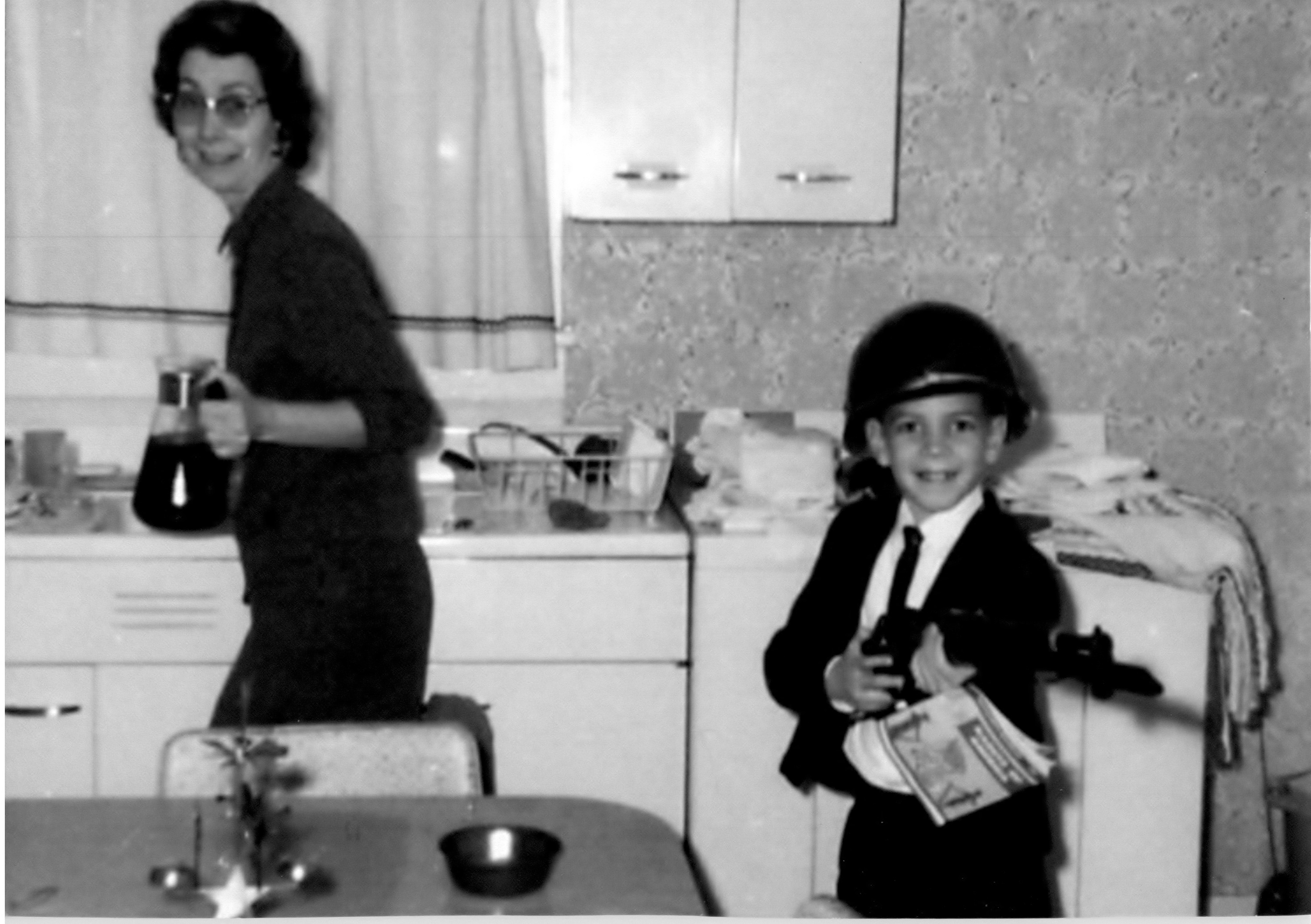
After Teresa opened countless toys geared for a three year old it was my turn. Sitting on top of my gifts was an official replica M1 Garand rifle equipped with a rubber bayonet and three wooden bullets in the clip. There was also helmet that somehow followed dad home from the Armory. Putting on the helmet and holding the rifle I assumed my best Vic Marrow pose. You can date yourself if you remember Vic as Sarge on Combat.

Dad had to be the one that snapped the picture with mom desperately trying to get out the picture. There is my evidence she must have known what this gift would lead to. The caption on the back of the snapshot says, “Brian pointing his new gun at Teresa.” To this day Teresa displays no visible effects from this incident.

Brian's new rrifle

Brian’s new rifle

The new rifle replaced a one piece rifle made by dad out of plywood. It was modeled after the guns carried by Roy Rogers and Gene Autry. Unfortunately the gun was broken in one of the fierce battles over possession of the grape vine hedge that ran along the alley.

The new weapon elevated me to the rank of Sargent in the local NRA, (Neighborhood Recreational Army.) I was ready to defend the block. But there was more to come with more gifts to open. Opening a tin that smelled of dad’s pipe tobacco three more wooden bullets were revealed. These were fashioned by dad at his basement workbench. They were painted with gold lacquer and looked just like the ones Sarge kept in his front pocket. I was locked and loaded with ammo to spare.

This was the dawn of the great Christmas battle of 1962. Few history books every recorded it but it was a turning point in the history of urban warfare. My buddy Butch this same Christmas received a bazooka that launched plastic shells on the enemy. We spent the afternoon defending the block against an unsuccessful attack by a real enemy…adulthood. We were able to fight it off for several more years. There were numerous  battles which were eventually won by grass cutting jobs, homework and puberty, forces more powerful than wooden bullets, rubber knives and plastic shells.

In the end, it was all part of growing up.

###

Go back

Your message has been sent

Warning
Warning
Warning
Warning

Warning.

Cobbler, Guns and Coffee, Oh My!

The late fifties and early sixties was an age before television began to lull us inside and present a distorted view of reality. Life outside of the house was exciting and adventuresome. Inside was for eating, sleeping and homework. Outside was for quests, socializing, learning and getting into trouble.  When we were ushered outside to play, mom’s words went something like this; “Go outside, play, have fun and don’t get into trouble.” The problem was, my idea of trouble and mom’s was usually different.

Trying to stay out of mischief often necessitated belonging to some youth organization which parents believed would somehow mold us into responsible adults. If you were one to push the limits, the threat of reform school hung over your head. For those who were not as rebellious, organizations such as 4-H, FFA, sports or Boy Scouts did the trick.  I tried the football route but quickly learned I did not care for my face being stepped on by kids twice my size. Boy Scouts became the route to salvation and a somewhat un-criminal life.

My brother Tom started the scouting experience in our family. Tom earned the Eagle Scout rank, which was an accomplishment for a young guy fighting Cystic Fibrosis. On a hot Nebraska July night, Tom, along with four other scouts pinned on the rank of Eagle in front of a crowd that required the Jug Brown Football Stadium behind the high school to hold all the guests.

Tom was my first lesson in dealing with a person of limited resources. I refuse to call him disabled as many people would want to today. For Tom, the disease was an inconvenience and he dealt with it as such. It might be better to label it as a distraction, but for him, it was never a disability. By fifth or sixth grade I was already taller than him, but in my mind he was bigger because he was after all, my big brother. Years later, I was honored to join him in the Eagle brotherhood. Today I measure each new Eagle Scout against Tom’s accomplishments and life style.

Scouting in Falls City was the adventure you read about in Boys Life or in the Boy Scout Handbook as you thumbed through it in the Boy Scout section of the J. C. Penny store. I couldn’t wait to be a scout. All of the tenderfoot requirements were memorized well before I signed on. I had visions of camping in the timber outside of town, wearing my uniform to school on scout days and leading a patrol through town at the start of a hike, each member dutifully following behind the flapping flag of the wolf patrol.  As a troop we never went on a fifty mile hike, saved a life or helped old ladies cross the street. But, when no one was looking and without even knowing it, we saved our own lives and helped each other cross the street from puberty to manhood.

We were a camping troop as well as one which believed in initiation ceremonies, PBA (pink belly association) flashlight army, snipe hunting and a few other things that might run counter to today’s Boy Scout philosophy or practices. We had fun and we learned valuable life skills. Skills such as how to ride in the back of a pickup without being pitched out or better yet, how to drive the same pickup, pre-license of course. Each scout in the troop eventually mastered the skill of boiling the hell out of coffee, making it the best tasting beverage you’ve ever had on a cold night, how to pop milo “borrowed” from a nearby field, and God forbid, how to shoot a gun.

Our Scoutmaster, Bill, was the father of two girls, so I believe he looked at each one of us as his sons. Bill worked in a local shop that made the cabinets for mobile homes. He was the first guy I knew who looked like he shoved softballs under his skin making his shirt sleeves stop above the biceps. He wasn’t showing off, he was a hardworking man who came by his muscles honestly. I used to do push ups every night hoping my arms would match his. I gave that idea up years ago.

On occasion, Bill would announce a shooting night for the next meeting. On these announced shooting nights, we were to bring our .22’s. On scout night, one week later, you would see a half-dozen pre-teenage boys walking down Stone Street, the main street of Falls City, toting guns. No one thought anything of it. Today, it would probably generate a SWAT team response and it would definitely create some form of national news coverage. After the meeting we would cut down through the city park (read, Death Drives a Ford Fairlane Sept. 7) then hike by way of an old service road taking us past the water and light plant down to the Nemaha River. Once there, we would plink at whatever we felt was a good target.

Old LP records were some of our favorite targets. We would roll LPs down the banks of the river and try to hit them before they ever reached the river bottom. Thinking back now I realize how dangerous that really was but somehow Bill controlled it. There were never any close calls that I remember. I also wouldn’t mind having a few of those LP’s back.  What should have caused even more alarm for the locals, was these same boys walking home in the dead of night carrying armament. How would you react today if you were sitting on your front porch enjoying the evening air and listening to the crickets and you saw four boys, dirty, sweaty and carrying on walking down your street, each carrying a rifle?

It was from these nights that I learned to shoot, gain respect and responsibility for what a weapon could do; lesson never taught, but lessons learned.

As a troop we were good at winter camping. Understand Nebraska winters are as cold as Nebraska summers are hot. There are many January days when the high temperature is still below zero. There is a description of Nebraska cold that says; “It was so cold outside that all the people’s words froze in mid-sentence. When spring came along, all the words thawed at once and you couldn’t hear yourself think.” Few people in their right mind venture out unless they were required to. That is unless you were a member of troop 393. Bill would sign us up every year for what was called the Winter Freeze Out camporee.

The winter I learned to sleep naked in my sleeping bag (well almost naked) was the most memorable of all of the winter events and a source for a few more stories that will follow. It was January. A fresh snow fell in the afternoon and by the time we got the tents set up, we were all ready to pack it in and go home. We were cold, wet and hungry. This changed when Bill made some of his ground coffee elixir; coffee boiled with the grounds then served in a tin camp cup, (which I still have.) You could smell the aroma of the coffee sneaking through the campsite like a winter butterfly fluttering from one bare branch to the next looking for some warmth. Once touched by the aroma, you were prompted to change your attitude and begin the task of fixing your evening meal. Many chose to fix easy camp food like hot dogs or “hobo” dinners. You made “hobo” dinners at home by throwing on to tin foil ground meat, vegetables, and whatever else you wanted in your meal. (I always liked a little A-1 in mine.) You formed a pouch around the concoction with the foil and packed it away. Once at the campsite, all you had to do was pitch it in the coals until the hamburger was cooked. When you opened the foil, the steam fogged your glasses and thawed your nose. The bouquet of smells made you feel like you were back at mom’s table with her special one pot meal.

Bill was in charge of dessert. His Dutch-oven peach cobbler was the crowning glory of camp food. I still get a little teary eyed when I reminisce about the taste of this delicacy. It is a lost taste, which cannot be duplicated without the old seasoned ovens and subzero nights. Bill would mix the cobbler in several dutch ovens, then bury the ovens in campfires around the encampment. No one dared lift a lid until Bill gave the orders to sample. Once done, the ovens shared an oozing peach and dough creation. The edges burnt from the coals and peaches on the bottom, caramelized. To make it even better, on this encampment, someone had the great idea to bring ice cream which of course needed no freezer. The vanilla ice cream, on top of hot cobbler, fresh cowboy coffee; excuse me while I wipe away the tears and the drool.

As the camp evening wore on, the younger scouts played flashlight army or buried themselves in their mummy bags thinking for some reason that was the way to stay warm.  The older scouts, those of us who actually had a few whiskers, sat around the fire, drank coffee and finished off the cobbler dished up in Styrofoam cups while Bill sat there blowing smoke rings from little cigars. They say that smell is great reminder. When I catch a whiff of tobacco smoke, campfire or coffee, it’s easy for me to conjure up those nights around the fire. When we stepped away from the fire we realized how cold it really was but for some reason instead of feeling colder, we felt older for the experience.

It was all part of growing up.

 ###

Go back

Your message has been sent

Warning
Warning
Warning
Warning

Warning.

Continue reading